
Agriculture
ZAMBIA AGRICULTURE SECTOR KEY FIGURES 2025, GDP, WORKFORCE, GROWTH
| GDP Contribution | Workforce Employed | Sector Growth 2025 | 2025/2026 Maize Harvest |
|---|---|---|---|
| 4.11% | 28.0% | +51.1% | 4,937,605 Mt |
Agriculture, forestry and fishing contributed 4.11% to Zambia’s GDP in 2025 and employed 28.0% of the workforce, as the sector rebounded 51.1% in real terms from 2024’s drought, on the back of a record 4,937,605 metric tonne maize harvest, the largest ever recorded in the country’s history.
The 2025/2026 season marks two consecutive years of recovery from the devastating 2023/2024 drought, with Zambia targeting 10 million metric tonnes of annual maize production, 3 million tonnes of soybeans, and 1 million tonnes of wheat, by 2031. The 2026 National Budget backs that target with K15.54 billion for agriculture, fisheries and livestock, 6.1% of total government spending.
Sector Size and Composition
Agriculture, forestry and fishing contributed 4.11% of Zambia’s nominal GDP in 2025, or ZMW 29.79 billion of the country’s ZMW 725.6 billion total, up from 2.83% in 2024[1]. That remains a small formal share relative to the sector’s employment footprint: the 2024 Labour Force Survey, the most recent available, found agriculture, forestry and fishing was the single largest employing industry, accounting for 28.0% of all employed persons, ahead of wholesale and retail trade at 23.9%[2]. The gap is explained largely by informality: 94.0% of agricultural employment sits in the informal sector, and agriculture accounts for just 6.0% of formal employment nationally versus 37.6% of informal employment[2]. Employment is heavily rural, with rural areas accounting for 84.7% of agricultural workers, and heavily concentrated by province: Central Province had the highest share of its workforce in agriculture at 56.0%, against just 10.4% in Copperbelt Province[2].
Within the sector, crop and animal production is the dominant activity, accounting for 65.8% of agriculture, forestry and fishing’s combined GDP in 2025, up from 53.8% in 2024 on the strength of the maize rebound, followed by forestry and logging at 25.8% and fishing and aquaculture at 8.4%[1].
Crops
Real output from crop and animal production surged 61.7% in 2025, reversing an 11.3% decline in 2024, and remains the largest single component of agricultural GDP[1].
Maize
Maize is Zambia’s dominant staple crop and the clearest driver of the sector’s 2025/2026 recovery. The 2025/2026 Crop Forecasting Survey, jointly conducted by the Zambia Statistics Agency and the Ministry of Agriculture, projected a harvest of 4,937,605 metric tonnes, the highest maize production ever recorded in the country’s history, exceeding the prior season’s record of 3.9 million metric tonnes[3]. Cabinet Secretary Patrick Kangwa attributed the performance to favourable weather, timely input distribution, and government interventions under the Comprehensive Agriculture Transformation Support Programme and the Eighth National Development Plan, marking two consecutive seasons of recovery since the climate-induced drought of 2023/2024[3][9]. A separate ZamStats food balance sheet for the same season put total maize supply, including carryover stocks, at 4,040,645 metric tonnes against national requirements of 3,539,024 metric tonnes, a surplus of 501,621 metric tonnes[4].
Other Crops
The 2025/2026 Crop Forecasting Survey also recorded increased production in rice, soybeans and wheat, part of the same broad-based recovery driving the maize record[3]. Government’s 2031 targets extend beyond maize to 3 million metric tonnes of soybeans and 1 million metric tonnes of wheat annually, alongside the 10 million tonne maize goal[3].
Livestock
Zambia’s national cattle population stood at 5,115,495 as of April 30, 2023, alongside 5,568,730 goats, 1,613,248 pigs and 308,354 sheep, according to the Zambia Statistics Agency’s Livestock Survey[5]. Cattle-raising involved 535,371 households nationally, with Southern Province accounting for the largest share at 31.5%; goat-raising involved 723,740 households, also led by Southern Province at 27.9%[5]. Disease was reported as the primary constraint facing livestock and poultry-raising households[5].
The government has established five disease-free compartments, at Chikankata, Chipata, Chisamba, Mumbwa and Namwala, expected to export at least 20,000 metric tonnes of beef per year, and plans four more, at Choma, Mazabuka, Mkushi and Sinda, in 2026[8]. Livestock vaccination coverage against diseases of national economic importance is targeted to reach 75.0% by the end of 2025, and Government will operationalise regional veterinary laboratories in Isoka, Mongu, Ndola and Solwezi, adding to existing labs in Chipata, Choma and Kasama[8].
Fisheries
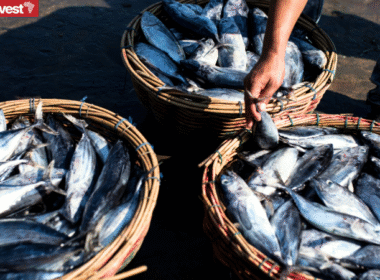
Fishing and aquaculture is the smallest of agriculture’s three GDP sub-components at 8.4% of agricultural GDP in 2025, but the fastest-growing in the 2024 downturn, when it was the only sub-sector to post real growth[1]. Domestic fish production rose 24.0% to 197,235 metric tonnes in 2024, from 159,043 metric tonnes in 2021, driven by a 90% increase in fingerling production to 475.1 million from 250 million over the same period, largely through the Zambia Aquaculture Enterprise Development Project[8]. Per capita fish consumption is targeted to reach 16 kilograms a year by 2026, up from 13.3 kilograms currently[8].
Policy Framework
The 2026 National Budget allocates K15.54 billion to agriculture, fisheries and livestock, 6.1% of the K253.1 billion total budget, within a K58.6 billion Economic Affairs function[8]. Of that sector allocation, K9.15 billion funds the Farmer Input Support Programme, K2.10 billion funds the Strategic Food Reserve, and K764.7 million funds animal health services, including the Zambia Beef Export Project[8].
The Farmer Input Support Programme’s e-voucher system has been rolled out to 74 districts, with the remaining 42 districts, all 116 nationally, covered for the 2025/2026 farming season[8]. Since 2022, the government has built six named dams, Kapekesa and Kawawa in Eastern Province, Muyembe in Luapula Province, Shikezhi in North-Western Province, and Chuundwe and Jongolo in Southern Province, benefiting more than 126,000 people and 221,000 livestock, alongside rehabilitating 10 more and maintaining 791 nationwide; in 2026 it plans nine new dams, seven completions and 300 dams maintained[8]. The government has also inaugurated the Bayer Itaba Seed Plant in Kabwe, one of the largest seed production facilities in Central and Southern Africa, and is developing drought-resistant varieties of maize, millet, sorghum, cowpea and cassava[8]. Government will introduce an Agricultural Marketing Bill and amend the Food Reserve Act, 2020, and the Agricultural Credits Act, 2010, to address unpredictability in agricultural markets and commodity prices[8].
The Bank of Zambia flags a reverse weather risk for the 2026/2027 season: forecasters see a high likelihood of El Nino conditions coinciding with the start of the season in November, which would reduce rainfall and could lower yields after two years of recovery[6].
Comprehensive Agriculture Transformation Support Programme
The Comprehensive Agriculture Transformation Support Programme, developed with the Food and Agriculture Organization at the Government of Zambia’s request, is the sector’s overarching 10-year strategic framework, running from 2024 to 2033 as Zambia’s second-generation National Agriculture Investment Plan[9]. It sets out the scale of the sector’s untapped potential: of Zambia’s 75 million hectares of land, 58%, or 42 million hectares, is arable, but only 10% to 15% is currently under cultivation[9]. On irrigation specifically, only 200,000 of a potential 2.75 million hectares are currently irrigated, and of the roughly 160 billion cubic metres of rainfall Zambia receives annually, only about 60 billion cubic metres is utilised[9].
Rural and Agricultural Finance
The Rural and Agricultural Finance Strategy 2025-2030, published by the Ministry of Finance and National Planning, targets the gap between rural and urban financial inclusion: rural financial inclusion rose from 51.2% in 2015 to 56.9% in 2020, according to FinScope, still well short of the 83.8% inclusion rate recorded in urban areas[10]. The strategy builds on the 2012 Rural Finance Policy and Strategy and aligns with the National Financial Inclusion Strategy II, 2024-2028, aiming to expand affordable financial products, secure land tenure for smallholder farmers, women and youth, and strengthen rural financial institutions and digital infrastructure[10].
Two specific facilities already show measurable uptake. The Sustainable Agriculture Financing Facility, introduced in 2023, had enabled 8,841 farmers to access loans worth K777.3 million as of end-June 2025[8]. The Zambia Credit Guarantee Scheme had extended K1.6 billion in loans to 19,819 small and medium enterprises and farmers as of end-August 2025, up sharply from just K10.0 million to 18 beneficiaries in 2021[8].
Investment Opportunities
The 2026 Budget funds a specific, named pipeline of agriculture projects: nine new dams and seven dam completions in 2026 alone, four additional disease-free beef export compartments at Choma, Mazabuka, Mkushi and Sinda, and the Zambia Beef Export Project under the K764.7 million animal health allocation[8]. The forthcoming Agricultural Marketing Bill and amendments to the Food Reserve Act and Agricultural Credits Act are both flagged by Government as upcoming legal-framework changes for the sector[8]. The Bayer Itaba Seed Plant in Kabwe is the most recent large-scale private investment the government has publicly credited in the sector, positioned as a strategic capacity addition for seed production in Central and Southern Africa[8].
Under CATSP, Government’s own figures put the size of the untapped opportunity in concrete terms: only 10% to 15% of Zambia’s 42 million hectares of arable land is under cultivation, and only 200,000 of a potential 2.75 million irrigable hectares are currently irrigated, using just 60 billion of the roughly 160 billion cubic metres of rainfall Zambia receives each year[9].
The US Department of State names agriculture as one of Zambia’s priority sectors for foreign investment, alongside energy and manufacturing, with the Zambia Development Agency’s investor portal providing sector-specific guidance[7]. It also reports that the growing role of various government entities in the sector, combined with ad hoc restrictions on the movement or sale of agricultural products, undermines market-based competition, and that trade regulations are sometimes issued by the Ministry of Agriculture by writ, with no clear process beyond a public announcement before they take effect[7].
Last Update: August 2026
References
- Zambia Statistics Agency, Final Annual GDP release, sectoral data
- Zambia Statistics Agency, 2024 Labour Force Survey Report
- Ministry of Agriculture, Zambia Projected to Produce Nearly 5 Million Metric Tonnes of Maize
- Zambia Statistics Agency, National Food Balance Sheet 2025/2026 Agricultural Marketing Season
- Zambia Statistics Agency, 2023 Livestock Survey Report
- Bank of Zambia, Monetary Policy Report, May 2026
- US Department of State, 2025 Zambia Investment Climate Statement
- Ministry of Finance and National Planning, 2026 Budget Speech
- Ministry of Agriculture, Comprehensive Agriculture Transformation Support Programme
- Ministry of Finance and National Planning, Rural and Agricultural Finance Strategy 2025-2030